Numbers own routing state
Allocation, ownership, inbound, outbound, and lifecycle.
First, numbers became first-class. Then, connections became self-serve. Next, trunk consolidation brings everything into one operating model.
Allocation, ownership, inbound, outbound, and lifecycle.
Guided setup, number linking, and readiness checks.
Bring number and connection routing into one model.
The foundation
The first delivery replaced scattered configuration with an explicit number record and assignment model. Calls can now resolve through the number a team owns or is allowed to use.
The durable control point between organizations, scenarios, providers, and call routing.
Register, allocate, activate, deactivate, and reassign.
Scenario routing and caller-ID authorization now follow the number model.
Super-admin management plus read-only organization visibility.
Ownership and routing rules stay consistent as numbers change.
The self-serve layer
The platform gained a guided flow for provider setup, credentials, safety checks, number linking, and readiness verification.
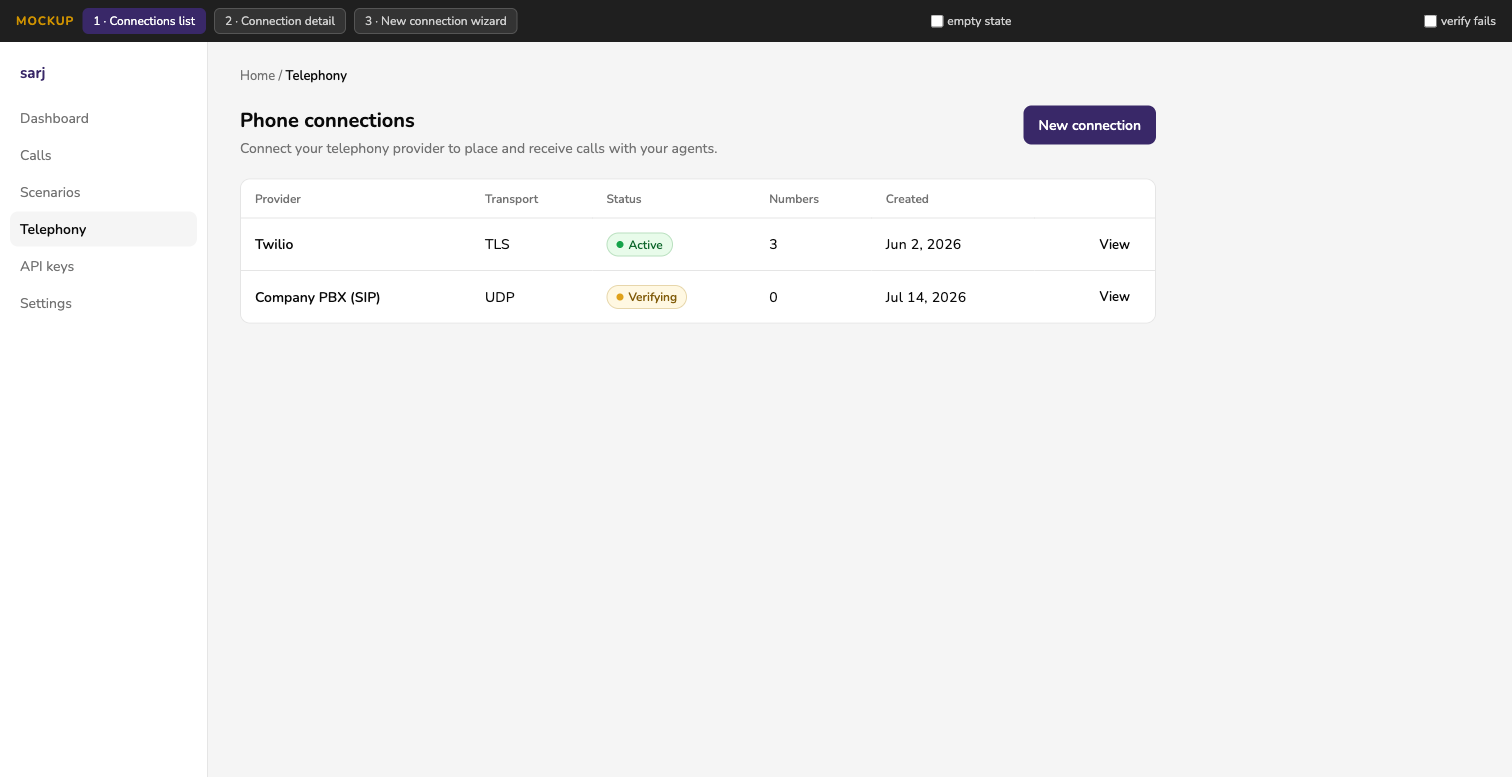
The important shift is visible here: PMs and operators can reason about a telephony connection as a managed object—with a provider, readiness status, linked numbers, and one guided setup flow. The values shown in the mock are illustrative.
The delivery ledger
Work is separated by what teams can use today and what is still being completed.
Numbers can be registered, assigned, activated, and routed for both inbound and outbound calls.
A guided setup for providers, credentials, safety checks, number linking, readiness, and ongoing management.
Register a number while setting up a connection, without entering the same routing configuration twice.
Support outbound-only connections and continue setup from the same place after an interruption, reducing duplicate configuration.
What comes next
Today, the product experience is unified, but routing still has overlapping configuration paths. The next phase removes that ambiguity.
Overlapping configuration makes ownership and support harder to explain.
Allocation, assignments, status, and routing choices.
Provider, route, credentials, verification, linked numbers.
Separate organization assignments and manual routing rules.
One routing model, a controlled transition, and clear failure states.
Who owns it, who may use it, and where inbound calls go.
How calls reach the provider and whether the path is ready.
Deterministic selection with observable failures.